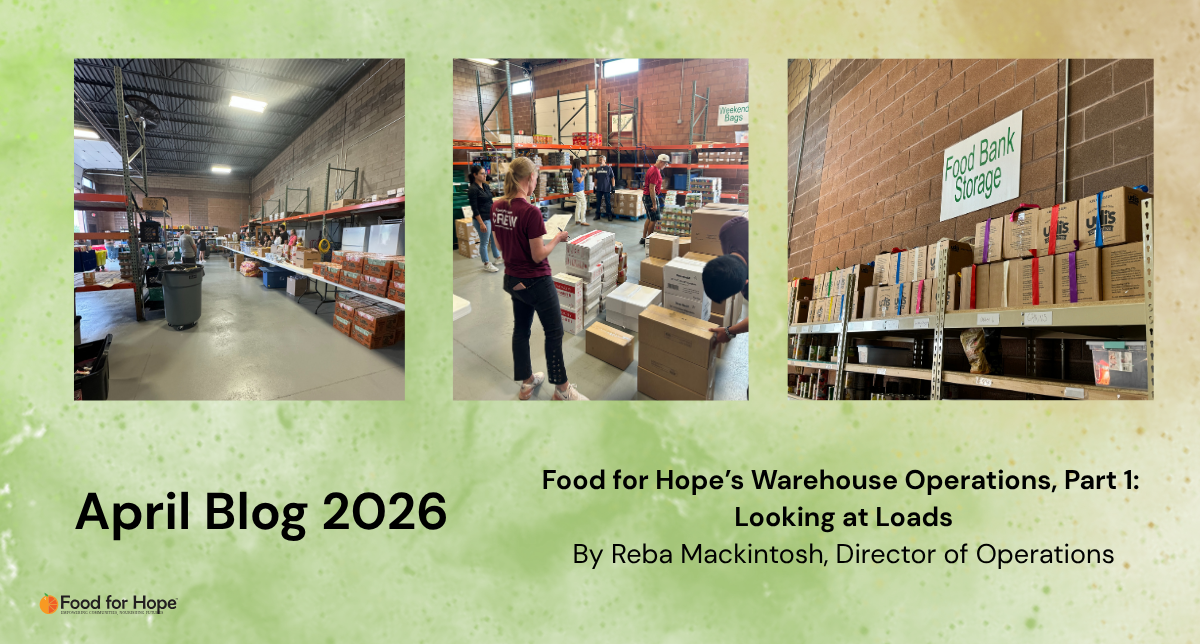
Pictures inside of our Warehouse in Thornton, CO!
By Reba Mackintosh, Director of Operations
Just over a year ago, we were spending hours on a weekly basis moving food and storage containers in and out of church classroom spaces so we could properly pack food for distribution. It was messy, creative, and fun! But, as Food for Hope has expanded, we now find ourselves in a warehouse where food arrives each week, is processed, and is distributed in a complex format that operates on multiple cycles. Learning warehouse optimization processes and lingo has been an adventure for our team!
In this two-part blog series, I am excited to introduce you to one of my new go-to phrases: “Loads and Outs.” “Loads” typically refers to the inbound items and relevant storage (for us, that’s food), while “Outs” refers to the management, movement, and shipping of those items.
This month, we are highlighting the inbound side of our cycles (stay tuned for part 2 in a future blog). Many people don’t know that we have a staff person—Kelly Parker—whose entire job is food acquisition and optimization. This means connecting with and maintaining partnerships with food suppliers, comparing offerings (size, cost, delivery cycles and availability, etc.), and ensuring we get the best value and most culturally relevant food for the students and families we serve, all at responsible costs. We’re talking dozens of suppliers and hundreds of thousands of pounds of food every year! It’s no doubt an art, and Kelly’s got skillz 🙂
I asked Kelly a few questions related to this side of our operations, and I’m excited to share her insights with you below. I hope this gives you a glimpse into and appreciation of the complicated process she takes on for Food for Hope every week.
Where does the majority of Food for Hope’s food come from?
From Jul 25 - Feb 26, we brought in over 200,000 pounds of food! (To put that in perspective, we brought in just over 247,000 pounds last school year, from Jul 24 - Jun 25.) Here’s the breakdown of where this year's food has come from so far:
Food Bank of the Rockies: 77%
Food Drives/Community Food Donations: 11%
Costco Business: 5%
We Don’t Waste: 5%
Grocery stores (King Soopers, Walmart, Woods): 1%
Other suppliers (Bimbo Bakery, Lily’s Toaster Grills, etc.): 1%
Of all the food that Food for Hope has received so far since July 2025, approximately how much of it has been purchased and how much has been donated?
Purchased: 83%
Donated: 17%
Of the food that is donated, how much is from food drives or donations, and how much comes from partner organizations?
Community Food Drives and Donations: 65%
Partner Organizations: 35%
What are "partner organizations" mentioned above, and how does Food for Hope's partnership with them work?
There are so many organizations (for-profit and non-profit alike) that share our basic desire to help others in need. When an organization's offerings line up with our needs, and we can work out all the logistical nightmares details, a beautiful partnership is born! We are fortunate enough to benefit from the generosity of several organizations by partnering with them on an ongoing basis to receive donated goods that directly stock our pantries. At a very basic level, this looks like sending our staff or volunteers once a week/month to pick up an agreed-upon amount of product and bring it back to our offices, where it is then parceled out to our various pantry locations. That's a very cut-and-dry way of putting it, and it doesn't begin to express the gratitude we feel toward these organizations and the utter amazement that they would dedicate their time, energy, and resources to partner with us in our mission to feed hungry kids. So I would like to briefly give a shout-out to some of these partner organizations here. Truly, thank you.
Bimbo Bakeries - Volunteers pick up loaves of bread and buns to stock our pantries every week
Lily's Toaster Grills - Staff/volunteers pick up grilled cheese sandwiches every month, made specifically through their donation program
We Don't Waste - Staff pick up fresh produce, meat, and and a variety of shelf stable items every week that would otherwise be thrown out
Of the food that is purchased, where does it come from?
Food Bank of the Rockies: 86%
Costco Business: 12%
Grocery stores (King Soopers, Walmart, Woods): 2%
How do you determine which suppliers to work with?
There are a variety of factors that determine which suppliers we work with. A huge factor is, of course, cost. We take the utmost care with the resources we have. When we receive a financial donation, the question should always be asked, "What is the best (most responsible, most effective) way to use this?" And when it comes to food, the answer involves a balance of providing the most nutritious food and feeding the most kids. We can feed the most kids with bricks of ramen. And we can provide the most nutrition with organic kale (and apparently beef liver, according to Google ). But the balance is somewhere in between, and we choose our suppliers accordingly.
Another factor is logistics. What's the order minimum? Do we have capacity in our warehouse to store it (space, refrigeration, etc.)? Do we have enough staff and volunteers to de-palletize an oversized order? Would we even be able to get an entire pallet of pears, for example, out to families before they go bad (not that anything like that has ever happened )? Does a supplier's delivery schedule work with ours?
Other factors: Does a supplier carry items that are culturally appropriate, popular with our families, locally sourced, etc.?
Can you share some examples of unique suppliers that Food for Hope partners with, and how that partnership plays out logistically?
One recent partnership we are excited about is with the new Community Loaves chapter in Thornton (the first in Colorado!). Community Loaves is an organization made up of community bakers who are passionate about helping people experiencing food insecurity. They will be providing Food for Hope with fresh-baked bread and energy cookies in the coming months to distribute to our families in need (and maybe to taste-test a few for myself, you know, for quality assurance purposes ).
Food for Hope’s operations require a tremendous amount of support from community partners, suppliers, volunteers, and our dedicated staff. This machine works together beautifully to support kids here in Adams County. Thanks for taking the time to learn more about our processes!