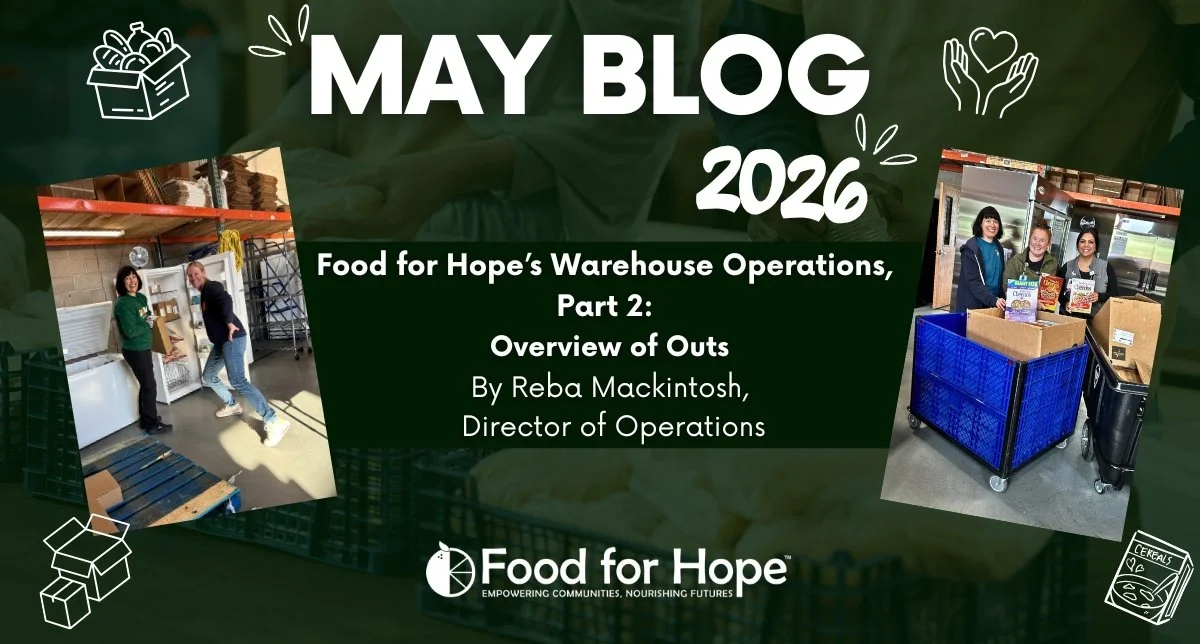
Food for Hope warehouse in Thornton, Colorado, showing Food Distribution Coordinator Laura McFadden, Director of Operations Reba Mackintosh, and volunteers working together during food distribution operations.
By Reba Mackintosh, Director of Operations
If you haven’t yet read Food for Hope’s Operations Team’s guest blog post from April, check it out! Here’s a recap: Food for Hope moved into our current warehouse space in August 2024. Since then, we’ve been working hard to optimize our warehouse efficiencies, specifically as it relates to loads (supplier relations, inbound food, and storage) and outs (management, movement, and shipment of food items). April’s blog featured part 1: Kelly Parker (Food Acquisition Coordinator) and I explained Food for Hope’s load cycles with an overview of our suppliers and food acquisition process. This month, Food Distribution Coordinator Laura McFadden and I bring you Part 2: Food for Hope’s outbound movement of all food in all programs.
Laura joined the Food for Hope team in 2023. At the time, her role was focused on ensuring food got to where it needed to be every single week. Still to this day, this process requires detail-oriented setup and organization, weekly preparation (and heavy lifting!) of the totes and bins used to transport food, as well as coordination of the volunteer team that moves it. Laura shines in this role; her attention to detail and patience to teach the “how” and “why” along the way make her an excellent teammate! And of course, as Food for Hope has grown, so has the work that goes into Laura’s food distribution responsibilities each week.
I asked Laura some questions about this side of our operations - see what she had to say below!
Describe a typical Monday for you.
Monday is supposed to be “typical,” but that word always makes me smile because there is almost always something unexpected waiting for us. We’re short a pallet of dried beans we ordered? No problem—we’ll substitute the great soup kits that just arrived. Running low on totes this week? Okay, we’ll stack and wrap pallets instead. Someone dropped off a large donation of ramen? Wonderful! Let’s get it distributed to our food pantries during this week’s restock.
Mondays are our biggest delivery days. It is "typical" to receive anywhere between 8,000 and 14,000 pounds of food. The food we order through Food Bank of the Rockies and Costco arrives at the start of the week, which means a busy day of receiving, organizing, and redistributing food throughout our programs. A large part of my job is preparing the warehouse for those deliveries and making sure every item ends up in the right place.
Thankfully, I don't have to do this alone. Our incredible volunteers are the heart of Monday’s operations. They help “de-palletize” deliveries (yes, we make up words around here!), take inventory, and sort food for our School Fuel Program, Weekend Bags Program, or into totes headed for our food pantries.
There are a lot of moving parts, and Mondays can feel a little chaotic. But what never ceases to amaze me is that by the end of the day, every pallet has been unloaded, every item redistributed, and everything is ready to get into the hands of the families we serve. That feeling never gets old.
How do Food for Hope’s weekly food distributions go out for delivery, and how is this determined?
The primary determining factor here is location; some schools or districts have transportation teams and staff that can pick up from our warehouse and deliver to the school. These loads are typically packed into "totes" - large tubs on wheels that can be rolled in and out of box trucks. We are SO THANKFUL for the heavy lift that these teams take on each week to make sure kids receive the nutritional support they need!
**Special shout-out to the Adams 12 Warehouse team! Not only do they deliver thousands of pounds of food for us every week, but during the November 2025 SNAP disruption, they delivered as much as four times the usual load, and even worked with the district’s Transportation team to store temporarily and distribute this added food to families within hours of receiving it.
For other sites that do not have these transportation or staffing pieces in place, Food for Hope has an incredible network of volunteers who load up their personal vehicles each week with food, drive across town, and haul it into the building. These loads are usually packed into "bins" - small Rubbermaid-type bins that can be lifted into vehicles, each packed with weekend bags and School Fuel snacks. Every week, we have a team of 10-12 delivery volunteers who haul these loads to Brighton, Henderson, Commerce City, Federal Heights, and beyond!
How do you determine which special food items (i.e., Birthday Bags, Meal Kits) will be well-received by the families you serve?
Each pantry we serve has its own quirks and characteristics, so I always keep those in mind when deciding where specialty items should go. For example, one pantry loves anything spicy, while another avoids sweet items. Understanding those preferences helps us ensure food is both appreciated and used.
I also rely heavily on feedback from the volunteers who work directly at each pantry. They complete inventory forms and let me know which items are especially popular, what they have too much of, and what they need more of. That feedback is incredibly valuable because it helps us respond to the real needs and tastes of the families we serve.
When we introduce a new item—like some of the meal kits we tested this spring—I usually start by sending a small number to each pantry. From there, we gather feedback and learn which items are the best fit for each location. It’s a process of listening, learning, and adjusting as we go.
Some things, though, are universally loved. Birthday Bags are always popular, and the meal kits have been a huge hit as well. Those special items bring a little extra joy, not just for the families receiving them, but for all of us who get to help put them together and share them with the community.
When you are working with the Community Engagement team to coordinate a food drive, how do you know what food items to ask for?
When coordinating a community food drive with our Community Engagement team, a big part of the process is understanding both what our families enjoy and what our programs need most. We think carefully about which food staples are easy for us to purchase in bulk and which items are harder to source because of cost, availability, or budget priorities.
For example, there are some staple items we can purchase efficiently in large quantities, while other items—like cereal, Cup of Noodles, or condiments—can be more difficult to keep stocked. That’s where community food drives can make a tremendous impact. I keep a close eye on our warehouse inventory and backstock shelves, so I always have a sense of which items we are running low on and which items would be most helpful to request.
One of the biggest strengths of our organization is communication. We are a small team at FFH, which can be challenging, but it also means we work very closely together. I’m able to do my job effectively because I’m in constant communication with both the Food Operations and Community Engagement teams. By working together, we can ensure food drives are thoughtful, responsive, and truly beneficial for the families we serve.
If you could improve one part of your weekly work process overnight, what would it be?
If I could improve one part of my weekly work process overnight, I’d probably start with a cushier warehouse floor! Just kidding… kind of.
But honestly, I’ve always dreamed of having one of those rotating closet systems like the one from Clueless—endless shelves, unlimited storage, and easy access to everything at the push of a button. Wouldn’t that be amazing in a warehouse setting?
And if I’m really dreaming big, I’d love a clone of myself so I could be in multiple places at once—spending time in the warehouse while also visiting each of our pantry locations. One of the best parts of this work is staying connected to both the behind-the-scenes operations and the people we serve, so having the ability to do both at the same time would be incredible.
Food for Hope relies on an incredible network to keep our mission moving forward. Together, our committed volunteers, community partners, vendors, and staff make it possible to serve and support children and families right here in our community. Thank you, Laura, for sharing your perspective on this amazing collaboration! And a big thanks to our readers for taking the time to learn more through this two-part series about how our operations come together!